
Registering the death of a Brazilian in the US
When a Brazilian dies in the United States, the American death certificate is not enough for Brazil. According to the Consulate in New York, for the death to be recognized there it has to be registered at the consulate or at a first-office civil registry (Cartório do 1º Ofício) in Brazil.
For families in the US, the consular route starts on e-Consular. The service is only for Brazilian citizens, dual nationals included. If the person was only American, the consulate does not register the death.
Who declares the death
New York prefers a Brazilian relative: the widow or widower, a child, a sibling or a parent. Failing that, the declarant can be a foreign national.
Chicago publishes the full list of who may declare, which runs from the head of the household and the spouse down to the doctor, the neighbor who learned of the death or the police, when the person was found dead.
On all three pages we read, the declaration can also be made by a representative authorized in writing by the declarant, and New York and Houston include the funeral director chosen by the family. Even so, New York says the request is not accepted by mail or by power of attorney: someone has to appear.
Of the pages we read, only Houston's spells out where to apply: the death is registered at the consular office for the jurisdiction where the person died, which is not necessarily where they lived.
New procedure guides, by email
We’ll email you when we publish a new procedure guide. No ads, and you can unsubscribe at any time.
How to apply, step by step
New York, Houston and Chicago follow the same path: a request on e-Consular, document validation and an in-person appointment with the originals.
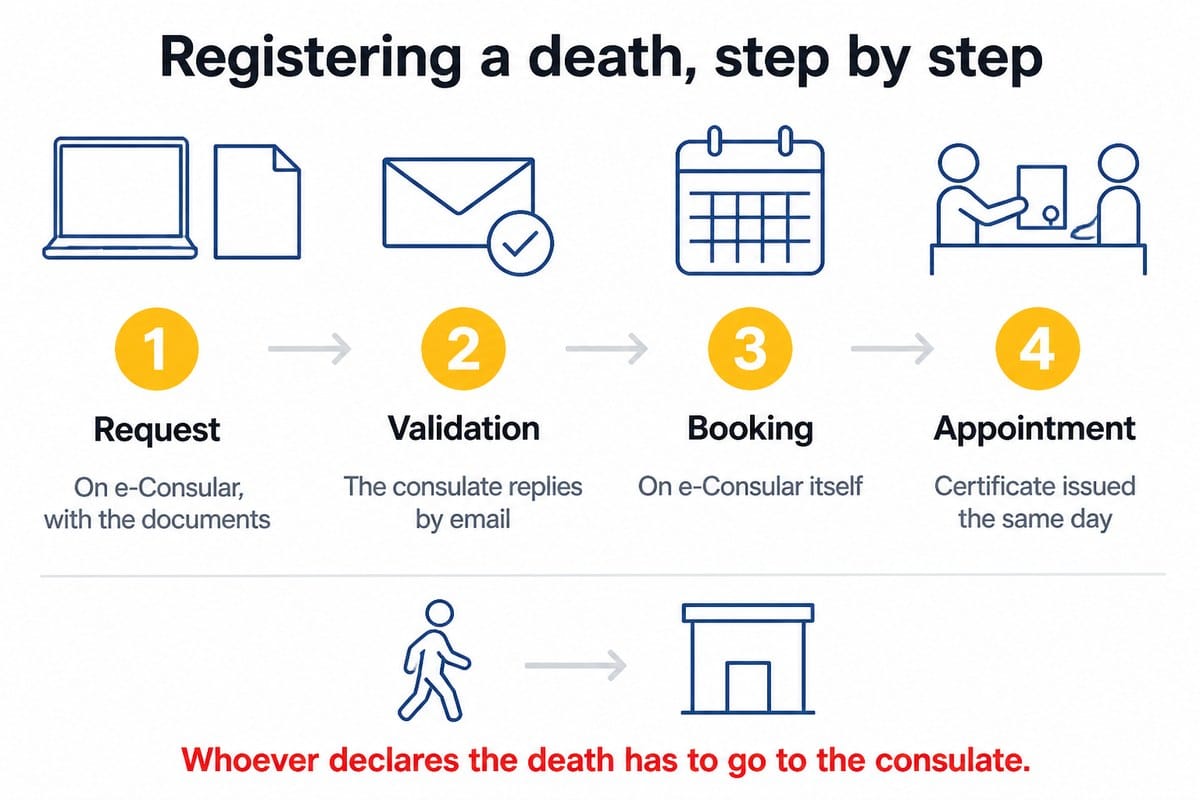
| Stage | What happens |
|---|---|
| 1. Request | Fill in the «Registro de óbito» service on e-Consular and upload the documents |
| 2. Validation | The consulate replies by email; Chicago asks for ten business days to validate |
| 3. Booking | Once the request is validated, the slot is booked on e-Consular itself |
| 4. Appointment | The declarant brings the originals and the certificate is issued the same day |
- The printed e-Consular form (New York accepts the short version)
- The US death certificate, original and copy, showing the cause of death
- A medical report with the cause of death, only if the certificate does not give it
- The cremation certificate, if there was a cremation
- The deceased’s photo ID, preferably the passport, even if expired
- At least one of these documents, or its details: CPF, birth certificate (with book, page and entry number), voter card, INSS or PIS/PASEP registration, benefit number (NB) or work booklet
- The declarant’s photo ID, such as a passport
Houston also asks for the Brazilian birth certificates of any children and, if the person was married, the Brazilian marriage certificate. Chicago accepts originals or certified copies, always with plain copies.
What it costs and how long it takes
The first copy of the consular death certificate is free on the New York, Houston and Chicago pages and in the Los Angeles and Miami fee tables. Each extra copy costs US$ 5 in Los Angeles, Miami and Chicago.
| Consulate | Validation | Issued | Questions |
|---|---|---|---|
| New York | reply by email | at the appointment | [email protected] |
| Houston | on e-Consular | on the day of the appointment | [email protected] |
| Chicago | ten business days | the same day | not given on its page |
In Chicago, extra copies are paid only by USPS money order made out to «Consulado-Geral do Brasil em Chicago», brought on the day. Personal checks and cards are not accepted, and each service needs its own money order.
After the consulate: transcription in Brazil
The consular certificate does not yet have full effect in Brazil. It has to be transcribed at the first-office civil registry of the deceased's home town or, if they had no domicile in Brazil, at the first office of the Federal District. All three consular pages say the same.
New York notes that Resolution 155/2012 of the National Council of Justice standardized this transcription of certificates issued abroad, and every first-office registry in the country must follow it.
Repatriating the body or the ashes
Taking the body home for burial in Brazil is a job for funeral homes. The one in the US works with the one in Brazil, which handles the arrival and the burial, and the shipment needs clearance from the departure airport's administration, which the funeral home obtains.
All those US documents, except the consular record, need an apostille. For the details, New York refers to Anvisa Resolution 33/2011.
The consulate does not pay for repatriation or the funeral.New York and Chicago say they have neither funds nor legal authority to repatriate remains, embalm, cremate or bury. Those costs fall on the family.
Frequently asked questions
Does Brazil's Foreign Ministry pay to fly the body home?
No. Chicago's answer is plain: there is no legal or budgetary provision to pay funeral costs or the transport of Brazilians who die abroad.
Can the death be registered by mail?
No. The request starts online, but the declarant, or the representative they authorized in writing, has to come to the consulate with the originals.
The deceased's passport had expired. Is it accepted?
Yes. New York, Houston and Chicago accept photo ID even if expired, and the passport is preferred.
How long does it take?
The certificate is issued on the day of the appointment. Before that comes the e-Consular validation, which takes up to ten business days in Chicago.
What if the person who died was an American spouse?
The consulate only registers the deaths of Brazilians. To repatriate a foreign national, Chicago asks for the US death certificate apostilled by the Secretary of State.
Each consulate has its own email and timings: see the pages for New York, Houston and Chicago, or the one for the consulate covering the city where the death occurred.
Details verified against the official sources.
consuladosbrasil.us is a private guide. We do not represent the Brazilian State and take no part in any consular service.
The information comes from official sources that sometimes disagree with one another, and is reviewed regularly. Confirm before you travel.