
US divorce in Brazil: how to make it valid

If you divorced in the United States, Brazilian records still show you as married until the decree is annotated. According to the Consulate in Houston, that annotation is what gives the American divorce legal effect in Brazil.
The route depends on one thing: what the decree settled besides ending the marriage. Read yours with that in mind before you gather any papers.
The three kinds of divorce
Houston sorts American divorces into three groups, and each one has its own route in Brazil:
| Kind | When it applies | Route in Brazil |
|---|---|---|
| Simple consensual | Both agreed and there was no division of property, custody of minor children or support | Straight to the registry |
| Qualified consensual | There was agreement, but the decree dealt with property, custody or support | Recognition by the STJ |
| Contested | The parties did not agree on all the terms | Recognition by the STJ |
Recognition (homologação) is Brazilian justice accepting the decree issued by the American court. For that you need to hire a lawyer, the consulate says.
New procedure guides, by email
We’ll email you when we publish a new procedure guide. No ads, and you can unsubscribe at any time.
Simple divorce: the registry route
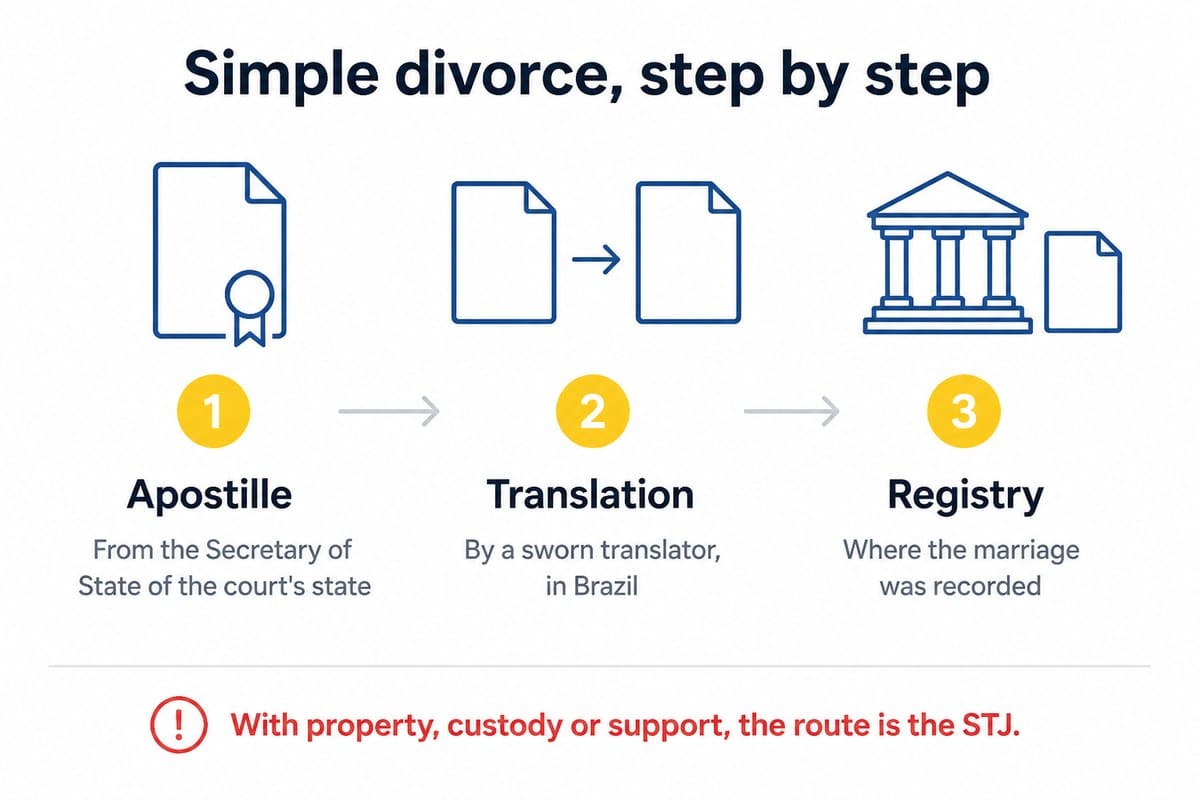
There are three steps, and none of them goes through the consulate:
- get the divorce decree apostilled by the Secretary of State of the US state where the divorce was granted;
- have the apostilled decree translated by a Brazilian sworn public translator, in Brazil;
- take the translation to the registry where the marriage was recorded in Brazil, or to the first-office registry (Cartório do 1º Ofício) where the consular marriage certificate was transcribed.
How the American apostille works is covered in the Hague apostille guide. Each state has its own Secretary of State, and the apostille comes from the state of the court, not the state you live in now.
Qualified or contested divorce: the STJ route
When the decree divided property, decided custody or set support, or when there was no agreement, the divorce has to be recognized by the Superior Court of Justice (STJ). Houston describes five stages:
- get the decree apostilled by the Secretary of State of the state where the divorce was granted;
- obtain a statement from your former spouse, signed before a notary public and apostilled, agreeing to recognition in Brazil;
- send both apostilled documents to your lawyer in Brazil, who arranges the sworn translation;
- the lawyer files the request to recognize the foreign judgment with the STJ;
- once it is recognized, the judgment letter goes to the registry of the marriage, which issues the certificate with the divorce annotated.
The former spouse’s statement is often the hard part, because it depends on someone you no longer agree with. Raise it with your lawyer before you start.
What if the marriage was never registered in Brazil?
Many people married in the US and never took the certificate to the consulate. In that case, Houston says the marriage has to be recorded first: the American marriage certificate is apostilled and translated by a sworn translator, transcribed at a first-office registry, and only then is the divorce annotated.
Registering the marriage through the consulate is explained in registering a US marriage in Brazil.
Why it is worth sorting out
Until the divorce is annotated, a Brazilian cannot register a new marriage at a consular office or get a passport in a new surname. The Consulate in Houston makes that link itself.
For the passport, the Brazilian passport in the US guide shows what to bring after the annotation.
- The US court’s divorce decree
- An apostille from the Secretary of State of the court’s state
- A sworn translation done in Brazil
- The registry of the marriage, or the first office of the transcription
- The marriage already recorded in Brazil, or recorded first
Frequently asked questions
Is a US divorce automatically valid in Brazil?
No. It only has legal effect in Brazil once it is annotated at a Brazilian registry.
Do I need a lawyer?
For a simple consensual divorce, the consulate does not mention one: the three steps end at the registry. For STJ recognition, yes, a lawyer is required.
Does the consulate do the annotation?
No. The apostille is American, the translation is done in Brazil and the annotation belongs to the registry. The consulate gives guidance but takes no part.
Can I remarry before the annotation?
Not at a Brazilian consulate: Houston says a new marriage can only be registered after the divorce is annotated.
How much does it cost?
The consulate publishes no fees, because nothing goes through it. The costs are the state apostille, the sworn translation, the registry and, for the STJ, the lawyer.
Each consulate’s contact details are on its page, such as Houston.
consuladosbrasil.us is a private guide. We do not represent the Brazilian State and take no part in any consular service.
The information comes from official sources that sometimes disagree with one another, and is reviewed regularly. Confirm before you file.