
Hague apostille between Brazil and the US: where it is done
Brazil and the United States are both parties to the Apostille Convention, and that decides who stamps what.
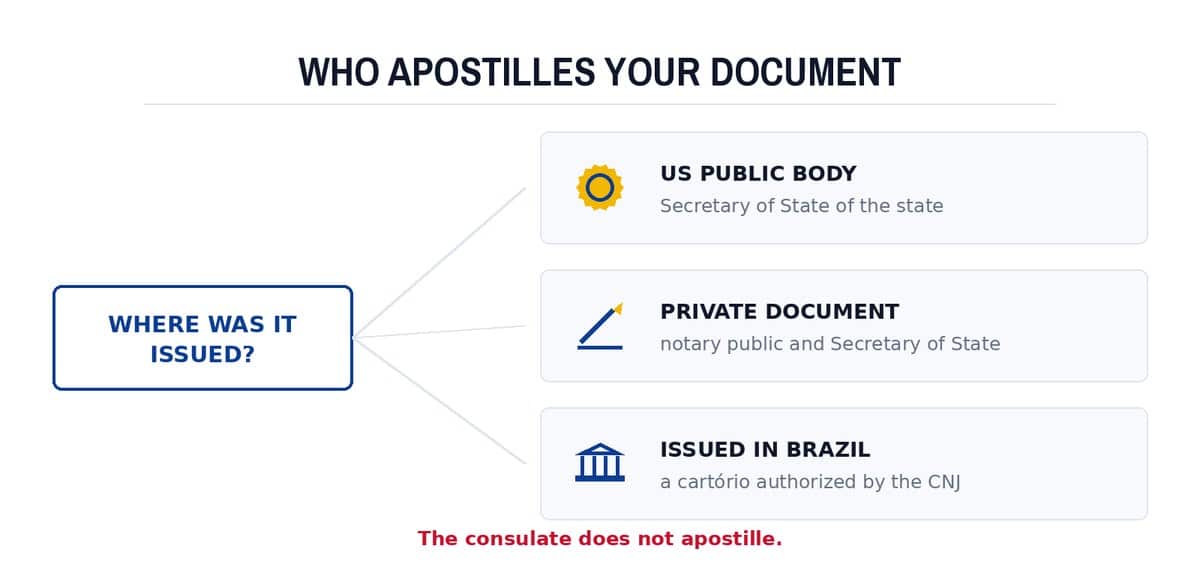
According to the Consular Portal's legalization page, a document issued in Brazil for use in the United States must be apostilled, and vice versa.
The consulate does not apostille: the Houston consulate explains that since 14 August 2016 it no longer legalizes foreign public documents.
A US document for use in Brazil
Birth, marriage and death certificates, court rulings and documents from public bodies go to the Secretary of State of the state that issued them, according to Houston.
Private documents, such as contracts and powers of attorney, are signed before a notary public and apostilled by the Secretary of State of the state where the notary lives.
Houston passes on a detail from the Texas community: the Texas Secretary of State is reportedly refusing documents without the notary's acknowledgment wording («State of…, County of…, This instrument was acknowledged before me…»). The consulate recommends asking the notary for that wording, in other states too.
A Brazilian document for use in the United States
In Brazil, the apostille is added by registry offices (cartórios) authorized by the National Council of Justice, according to Houston. Find a cartório near where the document was issued and check that it offers the service.
| Item | Detail |
|---|---|
| US public document | Secretary of State of the issuing state |
| US private document | notary public + Secretary of State |
| Brazilian document | cartório authorized by the CNJ |
- The original document
- Notary public acknowledgment, for private documents
- The notary’s acknowledgment wording, in Texas
Translation
If the US document goes to Brazil in English, Houston advises notarizing, apostilling and then having it translated by a sworn translator in Brazil. A document drafted in Portuguese can be signed before a notary who knows the language.
What usually needs an apostille
The Consulate in New York list gives the most common examples: birth, marriage and death certificates; powers of attorney, deeds and wills; adoption, divorce or custody judgments; and school and university documents. Also private powers of attorney and statements whose signature a notary has acknowledged.
Once apostilled, a US document is already valid in Brazil and does not need to go through the consulate. Since 2016, Brazilian consulates in the United States have also stopped recognizing the signatures of County Clerks.
The consulate does, however, still recognize Brazilians' signatures and certify copies of Brazilian documents.
For documents issued in Brazil, New York points to the National Council of Justice website, which explains how and where to get them apostilled. New York's questions go to legalizacao.novayork@itamaraty.gov.br.
Where to get an apostille in New York's jurisdiction
New York lists the apostille offices for the states in its jurisdiction: in New Jersey, the Department of the Treasury; in New York and Pennsylvania, the Department of State; and for Bermuda, the consulate points to the local government site (elections.gov.bm).
Outside that jurisdiction, it is the Secretary of State of the state that issued the document.
In Texas, ask the notary for the acknowledgment wording: without it the Secretary may refuse.Details verified on 4 October 2026.
We are not an official body. consuladosbrasil.us collects and checks information on Brazilian consulates in the United States, with no link to the Government of Brazil.
No appointments are booked here and nothing is charged for. Always confirm the detail with the consulate that covers you.